The UAE’s shift to mandatory e-invoicing is part of a broader push by the Federal Tax Authority (FTA) to digitize tax reporting, close gaps in VAT collection, and align the country’s invoicing infrastructure with international interoperability standards. For businesses operating in or with the UAE, this is not an optional upgrade — it is a phased, dated legal requirement.
Why finance teams underestimate this transition
Most organizations treat e-invoicing as an IT integration project. In practice, it is a finance and process transformation: it touches billing cycles, tax filing, ASP vendor selection, and system testing. Two specific risks emerge when preparation starts late: invoices that don’t conform to the required PINT-AE XML format can be rejected by the FTA network, which stalls both invoicing and collections; and ASP onboarding itself has a lead time that many businesses don’t budget for until the deadline is already close.
The phased rollout: dates, thresholds, and requirements
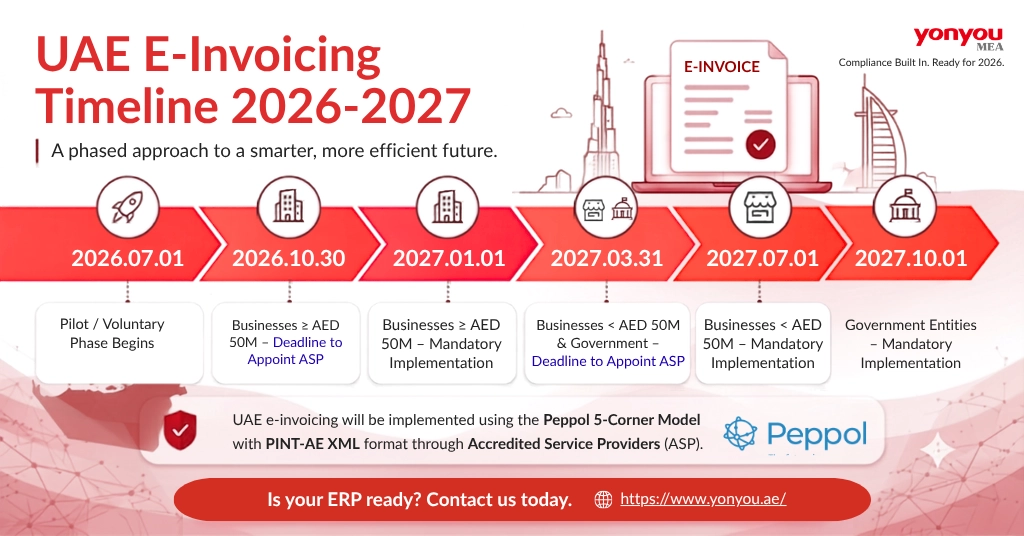
| Date | Applies to | Requirement |
|---|---|---|
| 1 Jul 2026 | All businesses | Pilot / voluntary phase opens |
| 30 Oct 2026 | Businesses ≥ AED 50M | Deadline to appoint an ASP |
| 1 Jan 2027 | Businesses ≥ AED 50M | Mandatory go-live |
| 31 Mar 2027 | Businesses < AED 50M and government | Deadline to appoint an ASP |
| 1 Jul 2027 | Businesses < AED 50M | Mandatory go-live |
| 1 Oct 2027 | Government entities | Mandatory go-live |
The architecture behind it: the Peppol 5-Corner model
Under this model, invoice data never passes directly between buyer and seller ERPs. Instead it routes through accredited intermediaries, with a real-time copy reaching the FTA.
Invoices must be formatted as PINT-AE XML — a UAE-specific extension of the international Peppol invoice standard — before they can move through this chain.
Readiness indicators to assess internally
The table below outlines qualitative readiness categories. Specific performance figures should be sourced from your own pilot testing or confirmed with your ERP provider before publishing externally.
| Area | Manual / legacy state | ASP-integrated state |
|---|---|---|
| Invoice format | Manual re-entry per invoice | Automated PINT-AE XML generation |
| Transmission | No FTA connectivity | Real-time transmission via Peppol |
| Audit trail | Fragmented across systems | Centralized, timestamped record |
| Deadline exposure | Undefined internal readiness date | Mapped against mandate dates |
What this means for your 2026-2027 planning cycle
ASP onboarding, system testing, and staff training all take lead time that shouldn’t be squeezed against a hard mandate date. Businesses closer to the AED 50M threshold in particular should treat the October 2026 ASP deadline as the real planning horizon, not the January 2027 go-live date.
Executive action checklist
- Confirm your applicable revenue tier and corresponding deadline
- Shortlist and evaluate Accredited Service Providers
- Audit current invoicing and ERP workflows for PINT-AE XML compatibility
- Assign an internal project owner spanning finance and IT
- Build a testing and parallel-run window ahead of the mandatory date
Ready to map your compliance path? Contact Yonyou to review your ERP’s e-invoicing readiness before the ASP deadline.
Related Posts
- UAE e-invoicing implementation timeline: what every business needs to know before 2027
- 7 common challenges businesses face preparing for UAE e-invoicing
- The Complete Guide to UAE E-Invoicing (2026): Timeline, Compliance & ERP Readiness
- UAE e-invoicing fines and disruption: what non-compliance actually costs