The UAE has attached a specific, gazetted penalty schedule to the e-invoicing mandate. These penalties apply once a business’s mandatory phase has started — voluntary users in the pilot phase are not exposed to them. But the fines are only part of the cost. The bigger risk for most businesses is operational disruption.
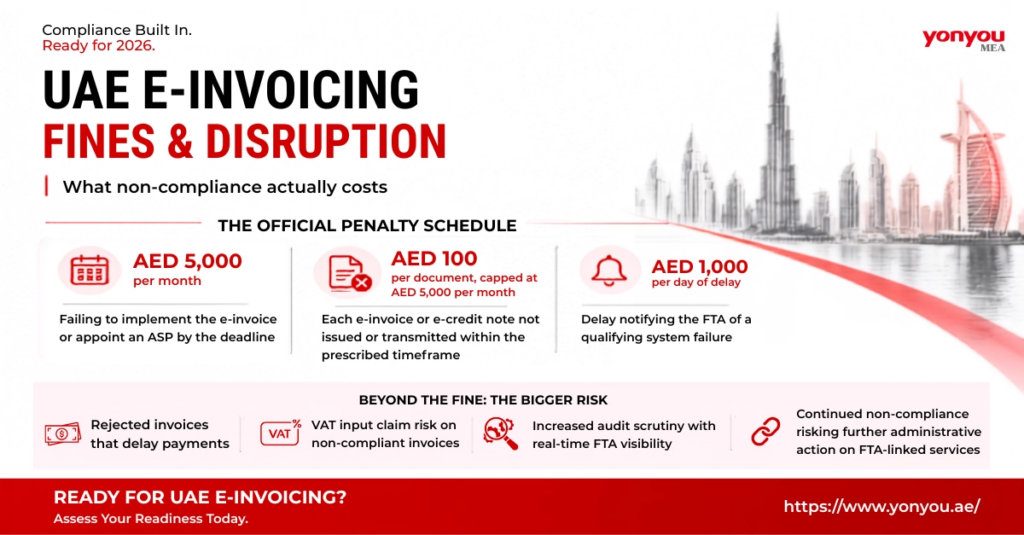
The official penalty schedule
| Violation | Penalty |
|---|---|
| Failing to implement the Electronic Invoicing System or appoint an ASP by the applicable deadline | AED 5,000 per month |
| Each e-invoice or e-credit note not issued or transmitted within the prescribed timeframe | AED 100 per document, capped at AED 5,000 per month |
| Delay notifying the FTA of a qualifying system failure | AED 1,000 per day of delay |
(Source: UAE Cabinet Decision No. 106 of 2025; Confirm current figures with the FTA or a qualified tax advisor before publishing, as enforcement details can be updated.)
Beyond the fine: what disruption looks like in practice
A missed ASP deadline or a malformed invoice doesn’t just trigger a fine, but it can stop a transaction from completing at all. Once a buyer’s system is live on the network, it may not be able to accept a non-compliant invoice. That means:
- Rejected invoices that delay payment collection, straining cash flow
- VAT input claim risk on invoices that don’t meet the required format
- Increased audit scrutiny, since e-invoicing gives the FTA real-time visibility into transaction data
- Continued non-compliance risking further administrative action on FTA-linked services
Why the cost compounds over time
The AED 5,000 monthly penalty for failing to appoint an ASP is not a one-time charge — it recurs every month the business remains non-compliant. For a business that misses its ASP deadline and takes three months to onboard a provider, that is a direct, avoidable cost stacked on top of the disruption to invoicing and collections.
The Path to Seamless Compliance with Yonyou
Yonyou’s Finance Cloud, built natively into both our YonSuite and YonBIP platforms, addresses these compliance challenges directly within your daily financial workflows.
The system automatically structures and generates every transaction into the precise XML formats required by the UAE framework for B2B and B2G scenarios. By utilizing direct API connectors to accredited service providers, it enables automated, real-time invoice transmission through the compliance framework’s five-corner model—completely eliminating manual work and human error.
Furthermore, Yonyou simplifies management for complex corporate structures. For multinationals managing cross-border tax compliance, our Global Tax Management module provides simultaneous, centralized control for both UAE and KSA requirements (including ZATCA integration). For domestic conglomerates, the multi-entity group finance architecture consolidates compliance monitoring for all UAE subsidiaries into a single, unified dashboard.
هل أنت مستعد لتقييم مدى جاهزيتك للفواتير الإلكترونية؟ بإمكان متخصصي الامتثال المالي لدينا مساعدتك في إجراء تحليل للفجوات ووضع خارطة طريق للتنفيذ مصممة خصيصًا لهيكل عملياتك في الإمارات العربية المتحدة.
منشورات ذات صلة
- الجدول الزمني لتطبيق نظام الفوترة الإلكترونية في الإمارات العربية المتحدة: ما تحتاج كل شركة إلى معرفته قبل عام 2027
- 7 تحديات شائعة تواجه الشركات عند الاستعداد للفوترة الإلكترونية في الإمارات العربية المتحدة
- الدليل الشامل للفواتير الإلكترونية في الإمارات العربية المتحدة (2026): الجدول الزمني، والامتثال، والاستعداد لأنظمة تخطيط موارد المؤسسات
- غرامات وتعطيل الفواتير الإلكترونية في الإمارات العربية المتحدة: التكلفة الحقيقية لعدم الامتثال