For Chinese enterprises operating manufacturing facilities in Africa, operational distance is not only geographic — it is systemic. When finance, supply chain, and procurement run on disconnected systems across time zones, headquarters visibility becomes dependent on email chains and manually compiled spreadsheets. Decisions are delayed. Errors compound. And as the overseas operation scales, the management gap widens.
This is the challenge Top New faced in Kenya — and how Yonyou YonSuite solved it.
About Top New: Chinese Garment Manufacturing in East Africa
Top New (铜牛) is a Guangdong-based textile manufacturer and a key node in China’s garment industry presence in sub-Saharan Africa. Its Kenya facility, located near Mombasa Road in Nairobi, employs approximately 1,500 workers and primarily serves the US apparel market through contract manufacturing — making it one of the more significant Chinese manufacturing investments in East Africa’s growing industrial base.
As digital adoption accelerates across Africa, cloud-based ERP systems, AI-driven quality control, and digital trade platforms are enabling greater visibility and efficiency in supply chains — but for Chinese enterprises with overseas factories, the challenge is more specific: how to maintain operational control and financial transparency across thousands of kilometres, without building expensive on-premise IT infrastructure at every site.
Top New’s Kenya factory was operating with three separate systems across procurement, inventory, and sales. Business data and financial data could not communicate with each other. Any attempt by Guangzhou headquarters to assess the factory’s performance required waiting for files sent across time zones — a structural bottleneck that limited both speed and accuracy of decision-making.
The Core Challenge: Management Opacity in Overseas Manufacturing
In a volatile operating environment, end-to-end visibility is the difference between reacting late and acting early. Companies need a clearer view across suppliers, logistics partners, inventory, transport routes, and cost exposure.
For Chinese enterprises building manufacturing capacity in Africa, this challenge takes a distinct form. Unlike domestic operations where systems, teams, and leadership operate in shared proximity, overseas factories face:
- Fragmented data environments — procurement, inventory, and sales systems that cannot share information in real time
- Manual financial reconciliation — vouchers, invoices, and statements processed offline and transmitted between geographies by email
- Cross-border collaboration friction — teams in China and Africa relying on informal messaging tools for approvals, announcements, and document sharing
- Headquarters visibility gaps — no single source of truth for the overseas facility’s daily operational status
These are not individual problems. They are the predictable consequence of scaling an overseas operation without unified digital infrastructure — and they affect virtually every Chinese enterprise that builds abroad.
The Solution — Yonyou YonSuite Deployment in Kenya
Top New selected Yonyou YonSuite, a cloud-native ERP platform integrating finance, supply chain management, and collaborative office tools, for deployment at its Kenya facility. Designed based on a cloud-native architecture, YonSuite provides growing enterprises with a unified platform encompassing marketing, manufacturing, procurement, financial, human resources, and office automation to support global business operations.
Implementation was structured around four operational priorities — each directly targeting a documented management gap:
1. Master Data Unification — One Source of Truth Across Geographies
All core data entities — organisational structures, customer records, supplier profiles, and material codes — were standardised under a unified coding framework within YonSuite. Data entered at the Kenya facility became immediately visible to the Guangzhou headquarters, eliminating the inconsistency between two previously isolated data environments. Without unified master data, every downstream process — from procurement to financial reporting — operates on a flawed foundation. This was the first problem solved.
2. Financial Process Automation — From Manual Vouchers to Real-Time Accounting
Upon completion of business transactions, financial vouchers are now generated automatically within YonSuite. General ledger, accounts receivable, accounts payable, and fixed assets management are fully integrated into a single financial layer. Finance teams no longer reconcile transactions manually against separate spreadsheets. Leadership gains real-time visibility into order status, cash position, and financial performance — without waiting for a report to arrive by email from across time zones.
3. Supply Chain End-to-End Digitalisation — Full Process Visibility
Procurement, inventory management, and sales processes — previously managed through disconnected offline systems — were fully migrated to YonSuite. Purchase orders, inbound and outbound stock movements, and invoice flows now move automatically through the platform. As Kenya’s position as East Africa’s logistics and industrial hub brings opportunity, it also exposes long-standing inefficiencies — and integrated ERP visibility has become the foundation of efficient, resilient supply chains. For Top New’s operation, this translated into a supply chain where every stage is traceable, every bottleneck is visible, and no process depends on a person manually updating a file.
4. Cross-Border Collaborative Office Integration — One Workspace for Two Continents
Yonyou’s YouSpace (友空间) module consolidated scheduling, announcements, document management, and approval workflows into a single mobile-accessible interface. Teams in Kenya and China now operate within one unified digital environment — approvals are processed on mobile, communications are traceable, and documentation does not depend on informal messaging channels. The result is a cross-border organisation that functions with the coordination of a co-located team.
Measured Results — Quantified Operational Impact
Following YonSuite deployment, Top New Kenya recorded the following verified operational improvements:
| Metric | Result |
|---|---|
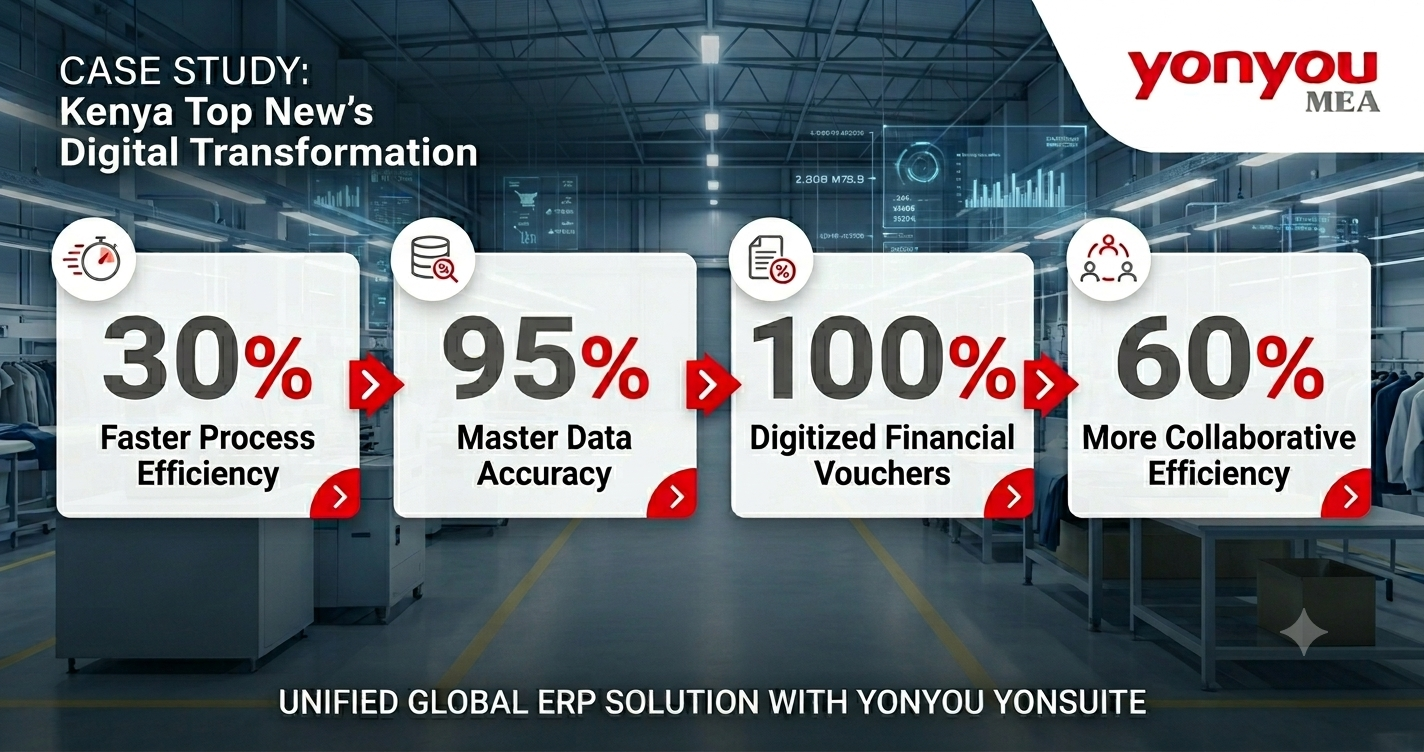
| Business process execution speed | +30% faster |
| Master data accuracy (customers, materials, suppliers) | 95%+ sustained |
| Financial voucher digitalisation | 100% — zero paper documents in transit |
| Cross-departmental collaboration efficiency | +60% improvement |
These are not projections. They are outcomes from a live deployment at a 1,500-person manufacturing facility operating across two continents.
Leadership Perspective — What Operational Clarity Actually Means
“After YonSuite went live, the management pulse of the overseas factory became clear, and the processes became standardised. This isn’t a slogan — it’s what you see every time you open the system.” — Wu Jiabao, CFO, Top New Kenya
The CFO’s framing is precise: the value delivered was not simply speed or efficiency — it was clarity. For an overseas manufacturing operation, management clarity is the precondition for every other improvement. A faster but opaque process is still unmanageable. A clear process — even before it is optimised — can be governed, measured, and improved.
What This Means for Chinese Enterprises Expanding into Africa
Chinese enterprises and African telecom operators have built strategic partnerships that facilitated secure, scalable digital ecosystems tailored to local economies — and the same principle applies to enterprise operations management. Chinese enterprises building in Africa are not simply relocating production. They are constructing management systems across language barriers, time zones, regulatory environments, and infrastructure constraints that differ fundamentally from domestic operations.
In 2025, the Middle East and Africa ERP market reached a valuation of USD 9.19 billion and is projected to grow to USD 10.68 billion in 2026 — reflecting accelerating enterprise demand for unified digital infrastructure across the region. For Chinese manufacturers, this market shift represents both an opportunity and a strategic imperative: enterprises that deploy unified ERP infrastructure early will build the governance foundation that makes sustainable African scale achievable. Those that delay will find that fragmented systems impose a growing tax on every additional unit of scale.
The Top New case is not an exceptional story. It is the operational baseline that any serious Chinese manufacturer in Africa should be working toward.
Why Yonyou MEA for Chinese Enterprises in Africa
Yonyou MEA is the Middle East and Africa division of Yonyou Network Technology — ranked among the global top 10 ERP providers by Gartner and recognised by IDC as the largest enterprise management software provider in China. With offices in Dubai, Riyadh and on-the-ground implementation capability across the MEA region, Yonyou MEA provides Chinese enterprises with something that global ERP vendors cannot: a solution built for Chinese enterprise operating models, delivered by a team with regional presence.
YonSuite is specifically designed for the cross-border operating environment — supporting multi-currency accounting, multi-language interfaces, multiple compliance standards, and cross-time-zone collaboration within a single cloud-native platform.
👉 Schedule a YonSuite consultation for your Africa operations →https://www.yonyou.ae/contact-us
👉 Read more client stories from Chinese enterprises in MEA → https://www.yonyou.ae/chinese-companies-going-global/