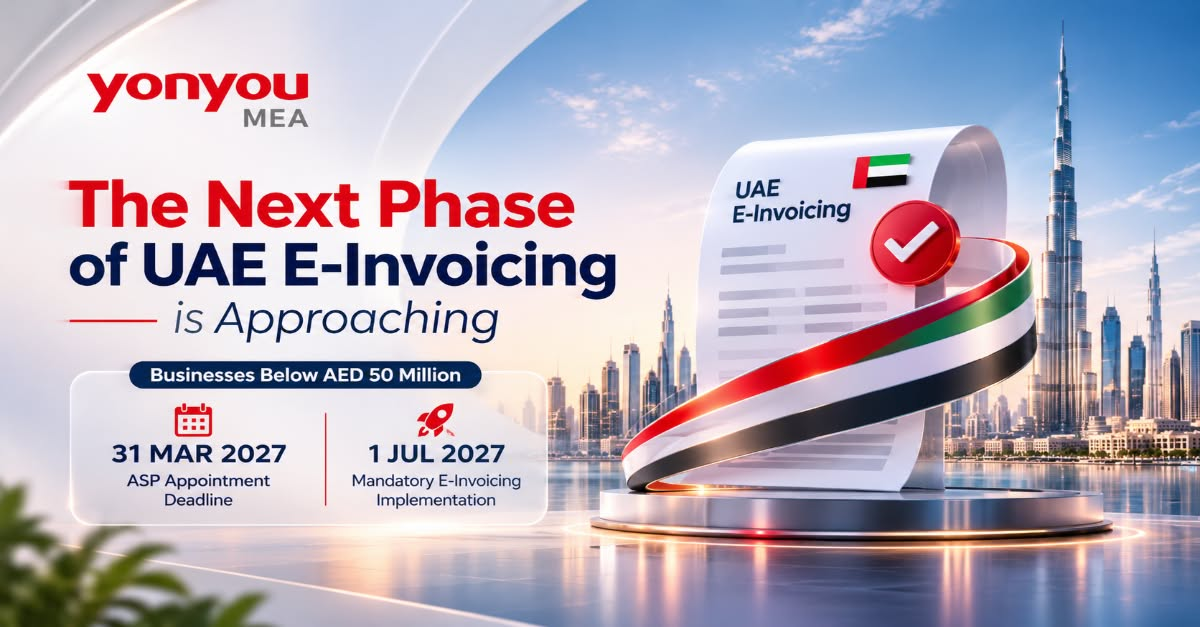
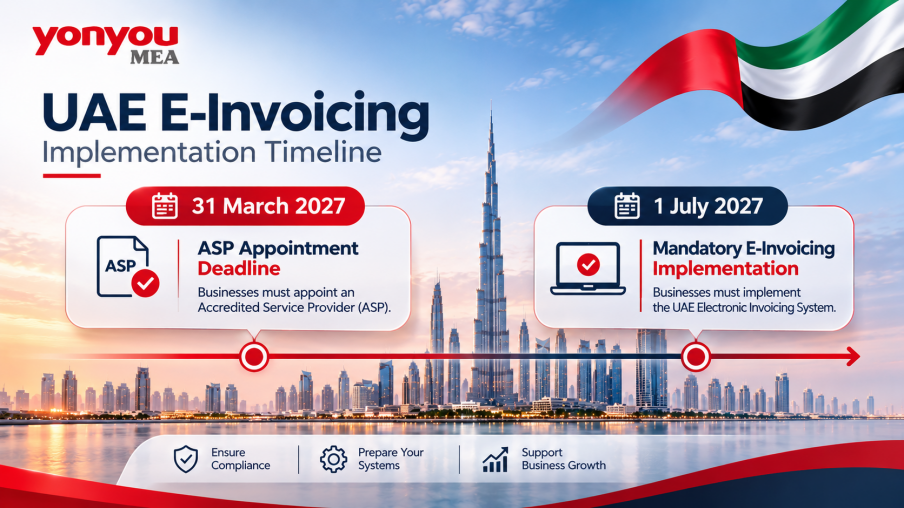
The UAE’s transition towards a fully digital invoicing ecosystem is entering its next major implementation stage. Businesses with annual revenues below AED 50 million must appoint an Accredited Service Provider (ASP) by 31 March 2027 and implement mandatory e-invoicing by 1 July 2027. With these milestones approaching, early preparation is becoming increasingly important for businesses looking to ensure a smooth and compliant transition.
Understanding the Next Phase of UAE E-Invoicing
The UAE Ministry of Finance is introducing a national Electronic Invoicing System as part of the country’s wider digital transformation strategy. The initiative aims to modernise invoicing processes, improve transparency, enhance tax compliance, and establish a standardised framework for electronic invoice exchange between businesses.
The implementation follows a phased approach based on annual business revenue, allowing organisations to prepare for the new requirements according to their respective timelines.
Following the first implementation group, which covers businesses with annual revenues of AED 50 million or more, attention is now turning to the next group: businesses with annual revenues below AED 50 million.
For these organisations, the transition is no longer something to consider in the distant future. It is time to assess existing systems, review internal processes, and begin preparing for the upcoming requirements.
Key UAE E-Invoicing Deadlines for Businesses Below AED 50 Million
According to the UAE Ministry of Finance’s implementation framework, businesses with annual revenues below AED 50 million must meet two important milestones:
1. 31 March 2027 – ASP Appointment Deadline
Businesses must appoint an Accredited Service Provider (ASP) by 31 March 2027.
An ASP plays an essential role in the UAE e-invoicing ecosystem, facilitating the validation, transmission, exchange, and reporting of electronic invoice data in accordance with the applicable technical requirements.
Selecting the right provider requires careful consideration of integration capabilities, technical compatibility, security, scalability, service quality, and commercial terms.
Businesses should avoid leaving provider selection until the final weeks before the deadline, as integration and onboarding activities require sufficient preparation.
2. 1 July 2027 – Mandatory E-Invoicing Implementation
From 1 July 2027, businesses belonging to this revenue category must implement the UAE Electronic Invoicing System for transactions within its scope.
By this date, organisations should have their relevant systems, processes, and technical integrations ready to issue, exchange, and report electronic invoices in accordance with the UAE requirements.
The transition involves more than simply replacing paper invoices with digital documents. It requires structured invoice data, compatible systems, and reliable communication with the selected ASP.
What Is an Electronic Invoice Under the UAE Framework?
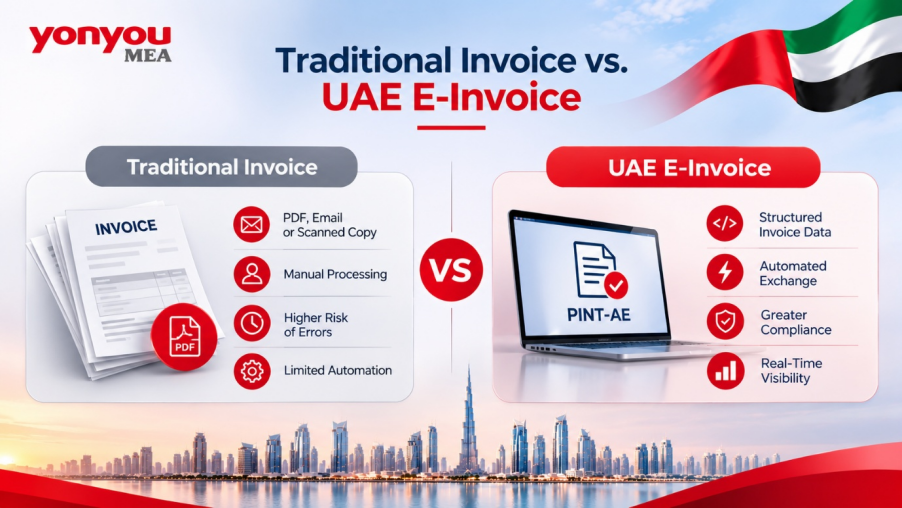
One of the most important points businesses need to understand is that an electronic invoice is not simply a PDF invoice sent by email.
Under the UAE framework, an electronic invoice is structured invoice data that can be issued, transmitted, received, and processed electronically.
The UAE system uses the PINT-AE specification, which establishes the required structure and data elements for electronic invoices and electronic credit notes.
This means that traditional invoicing methods, including PDF files, scanned documents, Word files, and email attachments, do not qualify as electronic invoices under the new framework.
Businesses must therefore evaluate whether their existing accounting and ERP systems can support the required structured data and integration processes.
How Does the UAE E-Invoicing System Work?
The UAE has adopted a decentralised Continuous Transaction Control and Exchange model, commonly referred to as the five-corner model.
This framework connects the supplier, buyer, their respective Accredited Service Providers, and the Federal Tax Authority.
The process generally involves the following stages:
- Invoice Creation: The supplier generates invoice data through its accounting or ERP system.
- Supplier ASP Validation: The supplier’s ASP validates the invoice data and ensures that it meets the applicable technical requirements.
- Invoice Exchange: The electronic invoice is transmitted through the Peppol network to the buyer’s ASP.
- Buyer Delivery: The buyer’s ASP validates and delivers the invoice to the recipient.
- FTA Reporting: Relevant tax data is reported electronically to the Federal Tax Authority through the prescribed process.
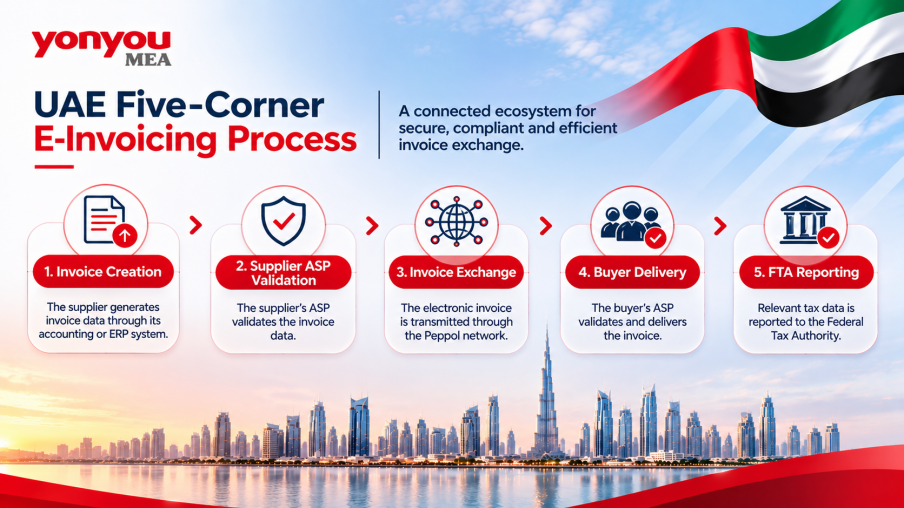
This approach supports standardised invoice exchange, improved data accuracy, and greater automation across business transactions.
Why ERP Readiness Matters in the E-Invoicing Transition
The introduction of mandatory e-invoicing presents an important opportunity for businesses to review and modernise their existing financial and operational systems.
An ERP platform plays a central role in this transition because it connects financial data, customer information, supplier records, purchasing activities, sales operations, and accounting workflows.
A properly prepared ERP environment can help businesses:
- Automate invoice generation and processing.
- Improve the accuracy and consistency of financial data.
- Reduce manual data entry and administrative workload.
- Support integration with Accredited Service Providers.
- Improve visibility across accounts receivable and accounts payable.
- Strengthen financial reporting and internal controls.
- Support scalable digital operations as regulatory requirements evolve.
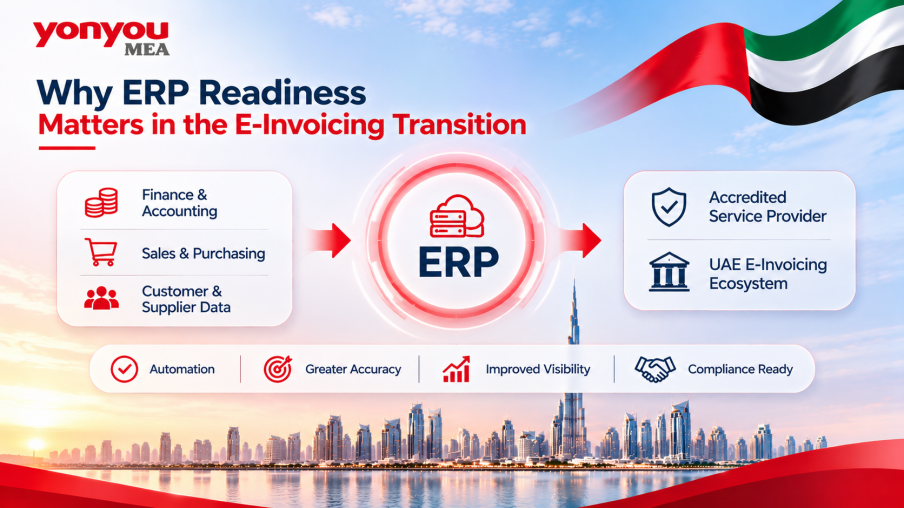
Rather than treating e-invoicing as an isolated compliance project, businesses should consider it part of their broader digital transformation strategy.
How Yonyou MEA Supports Businesses on Their E-Invoicing Journey
At Yonyou MEA, we recognise that regulatory changes require more than technical adjustments. They require a coordinated approach involving business processes, financial operations, data management, and enterprise technology.
Through our ERP solutions and digital transformation capabilities, we help businesses prepare their enterprise systems for evolving digital requirements.
Our approach focuses on supporting organisations in areas such as:
- ERP Readiness: Assessing existing enterprise systems and identifying the adjustments required to support electronic invoicing workflows.
- System Integration: Supporting integration requirements between ERP environments and relevant external service providers.
- Data Management: Improving the organisation and consistency of financial, customer, supplier, and transaction data.
- Process Automation: Helping streamline invoicing and financial workflows while reducing reliance on manual processes.
- Business Visibility: Supporting more connected financial operations and improved access to business information.
Our objective is to help organisations build a stronger digital foundation, improve operational efficiency, and prepare for the evolving requirements of the UAE business environment.
Start Preparing Before the Deadline
The next UAE e-invoicing implementation milestone is approaching, and businesses with annual revenues below AED 50 million should use this preparation window strategically.
Appointing an ASP by 31 March 2027 is an important first milestone, but successful implementation by 1 July 2027 will also depend on ERP readiness, accurate data, effective integration, and comprehensive testing.
Businesses that begin preparing early will have more time to evaluate their options, address technical challenges, and establish the processes required for a smoother transition.
Connect with Yonyou MEA to explore how our ERP and digital transformation solutions can support your business on its journey towards e-invoicing readiness.